
Irrigation software vs. pump station controls
On a golf course, the irrigation software decides which heads run and for how long. The pump station controls decide which pumps run, and how fast, so the pressure holds while those heads are on.
They are two separate computers, often from two different companies. On most courses neither one runs the other.
What the irrigation software does
This is Toro Lynx, Rain Bird CirrusPRO, Hunter Pilot, or whatever central your course runs. It holds the programs and the run times. It tells the satellites or decoders on the course which heads to turn on. It also adds up how much water it is asking for and tries to stay under a flow limit that somebody typed in.
On most courses it does not start a pump. It opens heads and expects the water to be there.
What the pump station controls do
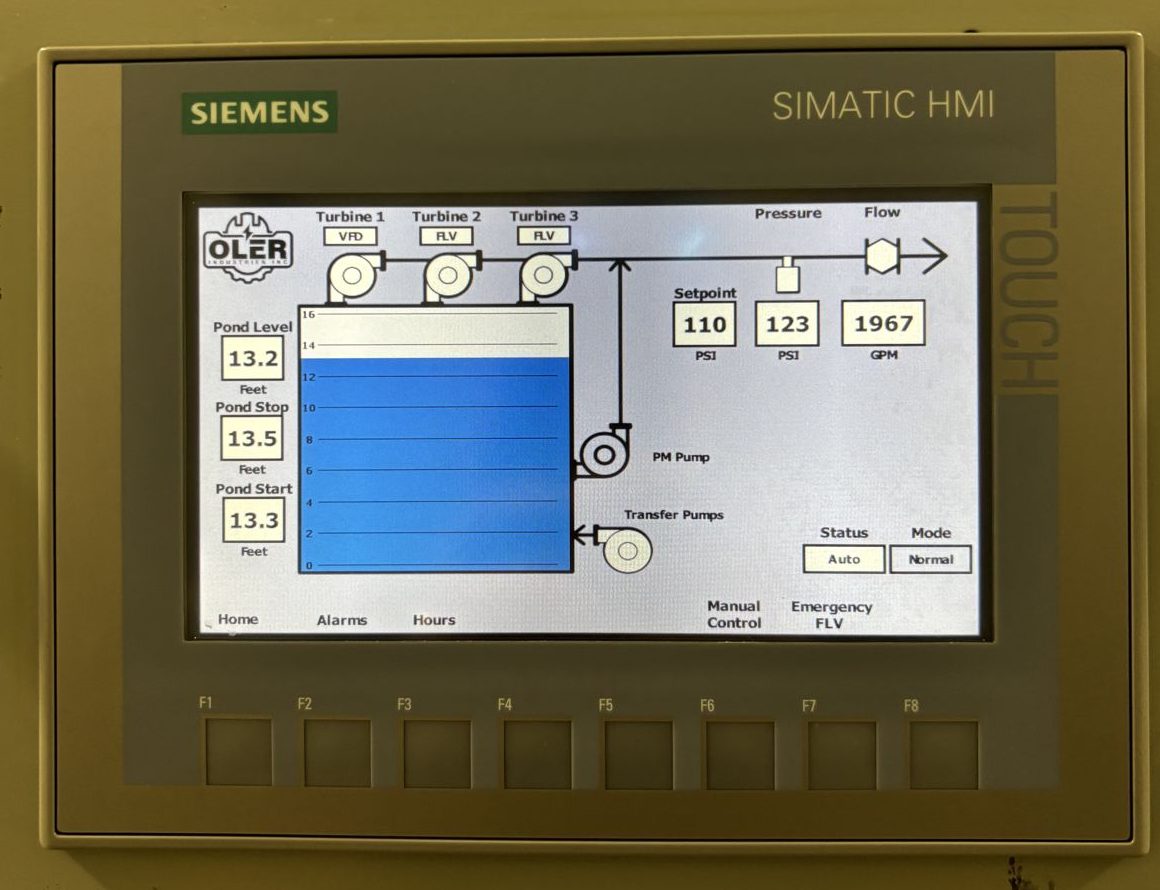
This is the panel in the pump house. A small industrial computer called a PLC watches the pressure leaving the station. When heads open and the pressure drops, it starts a pump. On a station with a variable frequency drive (VFD), it speeds that pump up and slows it down to hold the pressure. If one pump is not enough, it brings on the next one. When the heads close, it shuts the pumps off again. Many stations have a small pressure maintenance pump that keeps the pipe full in between.
The same panel watches for trouble: a low pond, low pressure, high pressure, a motor overload, a drive fault. Any of those can shut the station down to protect the pumps and the pipe.
It does not know your schedule. All it sees is pressure, flow and water level.
Side by side
| Question | Irrigation software | Pump station controls |
|---|---|---|
| Where it lives | The office computer, and the satellites or decoders on the course | The panel in the pump house |
| What it decides | Which heads run, when, and for how long | Which pumps run and how fast |
| What it sees | Run times and the flow it expects | Real pressure, real flow and water level |
| When it fails you see | One area that did not water | Low pressure everywhere, or an alarm |
| Who to call | Your irrigation tech or distributor | A controls electrician, or the company that built the station |
Where the two meet
They meet at one number: how many gallons a minute the station can deliver.
That number is typed into your irrigation software. If it is higher than what the station can really do, the software turns on more heads than the pumps can feed. Pressure sags and heads throw short. The station may shut itself down on low pressure or high flow. The schedule looks fine on the computer and the course is dry in the morning.
This shows up when something changes at the pump house and nobody changes the number in the central. A pump is out for a rebuild, or a drive has failed and one pump cannot run. If your station is down a pump, lower the flow limit in the irrigation software until the pump is back.
Some newer centrals can read pressure and flow from some pump stations, and some can pause watering when the station alarms. Whether yours can depends on the brands and on options the course may not have bought. Many older stations have no link at all. Your irrigation distributor can tell you what you have.
Which side has the problem
Start at the pump house. Look at the pressure gauge and the screen. Then find what you are seeing in this list.
- One area did not water
Pressure at the pump house was at setpoint and there was no alarm. That is the irrigation side. Check the program, the satellite or decoder, the wire and the valve.
- Pressure is low out on the course
The pump house is at setpoint but the course is not. Check the screen against the gauge first, because the sensor may be reading high. If they agree, the problem is in the pipe. Look for a partly closed valve or a stuck pressure reducing valve, then for a leak.
- Pressure is low and every pump is running
The software is asking for more than the station has, or there is a break. Look for water on the course first. Then check the flow limit in the central and what was scheduled, and check that every pump is really moving water.
- Pressure is low and a pump is not running
That is the pump station. Look for an alarm first. Then look for a pump switch left in Off.
- The alarm light is on, or the drive shows a fault
That is the pump station. Write down the exact words before anyone presses reset.
- Pumps start and stop all night with nothing scheduled
Something is leaking. It may be a pipe or a head on the course, or a check valve at the station. Count how many times the small pump starts overnight and watch whether the number grows.
- Pressure swings up and down while watering
That is usually the pump station: the controls, a sensor, or a relief valve that will not settle. It can also be the central starting and stopping big blocks of heads at once.
Before you call anyone
Write down the time, the pressure on the gauge, the pressure and flow on the screen, which pumps are running, and the exact words of any alarm. Take a photo of the screen before you press reset.
Then look up what the irrigation software was running at that time and how many gallons a minute it expected. With both sets of numbers side by side it is usually clear which side the problem is on.
What we work on
We work on the pump station side: the panel, the PLC, the screen, the drive, the sensors and the alarms. We do not program Lynx or CirrusPRO and we do not fix heads. Your irrigation tech or distributor does that.
Toro, Lynx, Rain Bird, CirrusPRO, Hunter and Pilot are trademarks of their owners. Controler and Oler Industries are not affiliated with any of them.
Not sure which side it is?
Call Warren at 250-581-2225 and tell him what the station is doing. Or book a free pump station review and we will get back to you.
Book a free pump station review
Other guides: Pump station spring start-up checklist and SyncroFlo Eagle alarms in plain words.